
What makes the perfect knight? Was it an honour? Was it valour? I believe everybody has their own definition of a perfect knight. Back when I was in primary school, one of my classmates got into trouble with the teacher. He, driven by impudence, made a comment in the class which infuriated the teacher. Naturally, my teacher asked him to leave the class. To my surprise, he stood up, apologised, and without complaining further, left the room. To my bigger surprise, the teacher later called him a ‘knight’ for despite his flaws as a student, he admitted to his ignorance and stayed true to his morals.
I took this little experience to heart when I wrote Branwen. To me, Branwen must be someone who is true to her beliefs. A belief that, at first glance, might be full of honour and valour, but could take a twisted form.
From the get go, I wanted Branwen to be the side character. Lots of books and movies have that trope where a side-character sometimes just steals the show. Well, for Kadmon Saga, that’s going to be Branwen.
Root
During my design process, Branwen is one of the rare scenarios where it began with a game mechanic as a concept. We had this idea of using a Spell Token to Summon a unit at instant speed. First, we experimented with Basic Units, but we soon found out that such an ability is extremely strong in a game like Legions of Kadmon. I decided to transfer it to one of the Sovereigns’ abilities and built something out of that. Branwen is the product.
Character Inspirations
Lady Brienne of Tarth (A Song of Ice and Fire)

When I first read ‘A Clash of Kings’, the character Lady Brienne reminded me so much about my primary school friend whom I had written about in the prelude. Lady Brienne was powerful, out of place, and new to her job. Early on in her knighthood, she was condemned for crimes she didn’t commit. She was put into the test, and went through her fair share of ordeal. Yet, throughout all that, she was still true to her words.
Her virtues, however, came with a sense of naivety. It was the conflict between her virtuous values and her naivety that makes Lady Brienne such a compelling character. It sets her apart from a normal hero, almost as if she was trapped in ‘the ordeal’ portion of the Hero’s Journey because of her stubbornness to accept changes.
Well… just like any other ‘character inspirations’ that is how I understand Lady Brienne’s character, and how I wish to interpret it to help me design Branwen towards that direction.
Cressida (Mockingjay Movies)

When it comes to looks, my biggest inspiration for Branwen would be Cressida, specifically her portrayal by Natalie Dormer in ‘Mockingjay’ movies. Early on, I wanted Branwen to portray the concept of asymmetry. Firstly, it was due to her dual Undead-Spirit unit type. Secondly, I wished to portray the conflict of her virtue and naivety through an asymmetrical look. Everytime I imagined asymmetry, Cressida popped into my mind, mainly because of how badass she looked with her asymmetric hair style.
It was this concept of asymmetry that followed through until the very end of Branwen’s design. There are many more aspects of asymmetry that are presented in Branwen’s character. She has heterochromia, which means that her irises are of two different colours. On her death, she also adopted a unique asymmetry. Her body was of rotting flesh, while her head was one spectral in nature.
Story Inspirations
Branwen plays a unique role in the story. For the most part, she is a mentor figure. She is honoured by her allies, and feared by her enemies. However, Branwen has a dark past. I wanted Branwen to be unlike traditional mentor-like figures. She isn’t exactly my Gandalf. She is a mentor who hasn’t been through everything. A heroic figure, of which, the act of mentoring is also a part of her hero’s journey.
Can she get past her naivety and do what she must for the greater good? Or will she stay true to her word, and become the perfect knight?
Gameplay Design & History
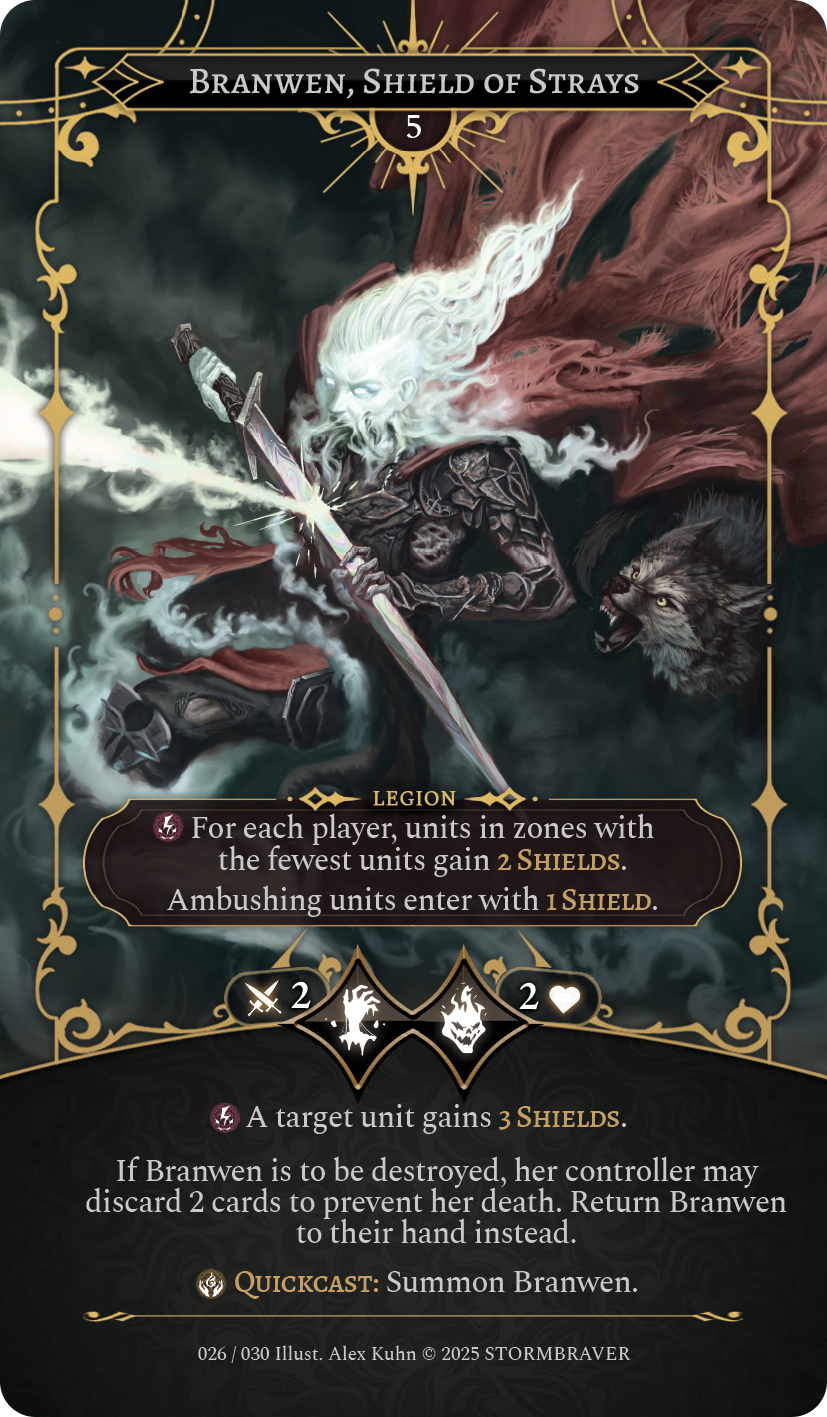
Shield is actually a mechanic introduced because healing (removing damage counters) just couldn’t work in this game. Right after I’ve settled with shields, I immediately begin my work on making Branwen the ‘Shield Sovereign’. In a way, you can think of Branwen’s mechanic to be the antithesis of Kilgore’s. Instead of dishing out damage, Branwen would be dishing out shields with the intention to make combat a little more complex.
The design principle of Branwen’s gameplay is: “Split-Second Protection”
Split-Second Shield
Unlike Michael who is designed to give an aura-feel to his effects, I want to promote the idea of speed for Branwen. In Legions of Kadmon, the use of Quickcast promotes this idea of speed. But the thing is, every shield based effect in the game uses Quickcast. How then could I hasten Quickcast?
There is actually a single mechanic in the game that is even quicker than Quickcast. However, that mechanic can only be accessed by Ruling Sovereigns and not Sovereign Vassals. I am talking about Calamities. No players can respond to a Calamity giving it the impression that nothing could be quicker than that.
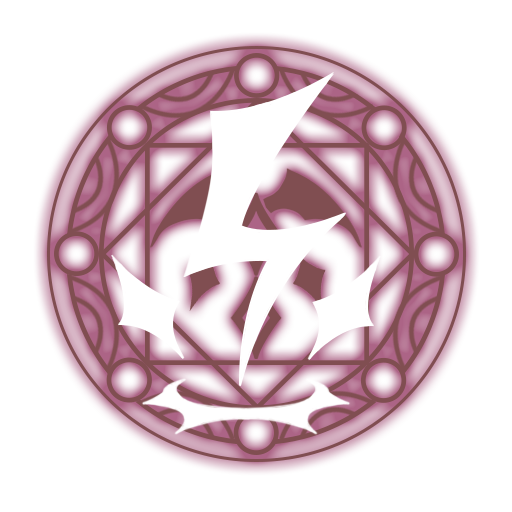
How then, can I introduce Calamity as a Vassal Effect?
‘Enter the Battlefield’ effects are popular in card games. Let’s take for example the magical unicorns from Unstable Unicorns. There are abilities owned by units that become triggered when a unicorn enters the stable. It is a very common mechanic that I used to explore a lot in the early iteration of the game but later scrapped due to complexity and high power units. The only one that stayed till the very end is Branwen’s ability.

I used to explain her ability by writing the clause “When Branwen enters the battlefield…” Later I changed it to using a Calamity Icon, making Branwen stand out from the other Sovereigns, being the only one with a Calamity as Vassal Effect. Branwen’s Vassal Calamity gives 3 Shields to any unit. 3 Shields, by the way, pretty much protect a unit from all forms of damage spells. And since it’s a Calamity, the adding of Shields to the target unit cannot be prevented in any conceivable way.
Calamity actually fits well with Branwen’s Root. Using a Cast Token to Summon Branwen at instant speed. Calamity only triggers when Branwen becomes a Vassal. The only way to become a Vassal is to Summon a unit. When Branwen is summoned, she triggers her calamity, awarding shields. And her Spell allows her to be summoned at Quickcast speed. All that gives you a Split-Second Shield.
Recursion

Branwen also comes with a passive ability as a Vassal. One of Branwen’s finest qualities is her resilience. I wanted to portray this in her Vassal effect. As such, whenever Branwen perishes as a Vassal, the player that controlled her can prevent her death by paying a toll of 2 cards.
There is some history when it comes to deciding how many cards to discard. We first started with 1, but that seemed to be incredibly powerful. It guarantees that Branwen’s owner can always have her in their possession. Psychologically, it increases Branwen’s safety when summoned greatly because now, no other players find it worth it to sling their spells at Branwen. 2 cards seemed to be the right number, and it added more decision point to Branwen’s owner whether or not it is worth it to keep Branwen to themselves.
Timing Mastery
Branwen’s everything about timing. Her spell and summon essentially have the same effect, which forces players to play her a certain way. This means that her effectiveness as a card depends a lot on WHEN a player decides to play her. Too early, then you will miss out on a great shield and extra bonus contribution. Too late, then you’ll end up with a full Vassal and you can’t even play her at all.
Her death also requires good timing to handle well. You don’t want her to be destroyed if you are not going to die in that Cycle. Because the next Cycle, you’ll end up with an extremely weak hand and that might cost you even more. By saving Branwen at the wrong time, you might end up losing the entire game. It is very important to know when to let go, and move on.
Illustrating Branwen
I first contacted Alex Kuhn when I found out that he too was making his own card game. I took a glance and I fell in love almost immediately. Alex fitted right in among Legions of Kadmon’s artists with his gritty horror style.
Her sword is a very important component of the illustration. The sword is made out of Draxarian Metal (a very special metal in Morbidia), henceforth the iridescent colour. Even though she was all about shields, Branwen still wields a sword, but she used this sword like a shield. In the illustration, she used it to block an incoming bullet, which is meant to put emphasis on her sword’s name—Lifekeeper. A name she had adopted to become her ideals and values.
Inside Branwen’s Illustration, you’ll notice that there’s a canine right behind her. She is protecting this canine from the incoming bullet. One of the many compositions I really loved from Magic the Gathering artworks were one depicting a character protecting the other (Heroic Intervention, etc). I really wanted Branwen to be presented in a similar way. Alex captured exactly how I imagined her.


Leave a Reply